Walt PennyCOIN SECRETS
Launch promo ends in 00:00:00
Walt Penny Thirty-One Years At The Vault

One Of These Pennies Is Worth A Cent. The Other Is Worth More Than A Used Car.

Same portrait, same colour, same weight in your hand. Nothing about the way they look tells you which is which — until you know what to read. Thirty-one years at a bank in Ohio with first look at every coin in the vault, written down in the order I actually check them.

Instant download · Yours forever

28Chapters
146Pages
5 minCoin Check
Walt Penny at his desk with his coin albums

“A video has to be exciting for eight minutes. A manual only has to be true.”

Walt Penny · Before You Begin
Section I · The Manual

Everything I Learned With First Look At The Vault

This is a working manual, not a coffee table book. There are no photographs of million-dollar coins in here that you will never own.

For thirty-one years I worked at a bank in Ohio, and for most of them I had a standing arrangement with the vault: whatever coin came in, I got first look at it before it went back out. I have gone through more pennies than I can count. I have also watched a lot of good people get taken, and watched a lot of decent coins get ruined by a jar of vinegar and a toothbrush.

So the book is written with two goals, and they pull in the same direction. The first is to teach you to actually find the coins that are worth money. The second, which matters just as much, is to keep you from wasting your Saturdays on coins that are not — and from destroying the ones you do find.

“You are probably not going to find a coin worth fifty thousand dollars in your change. Somebody does, every year, and that is real. But the ordinary result is a coin worth forty, and every so often something worth a few hundred. Do that steadily for a year and you have built a collection worth real money out of money you already had. That is the honest promise, and it is a better one than the exciting version.”

Every chapter has the same bones. It opens with what you are looking for and why it exists. It shows you the exact thing to check. It gives you a value range for 2026. It tells you what the fakes and lookalikes are, because for every valuable coin there is somebody making a counterfeit of it. And it closes with what to do next if you find one.

Some of what is in here comes from videos I have posted. Most of it goes further than any video could, because a video has to be exciting for eight minutes and a manual only has to be true.

Section II · The Difference

Age Is One Factor Out Of Four — And Usually The Weakest

I can hand you a coin from 1918 worth four cents and a coin from 1999 worth six hundred dollars. I do it at coin club meetings just to watch the reaction.

The way most people search Sorting by date, hoping for old
  • Pulls anything pre-1950 and puts the rest back — missing the modern cents worth hundreds that are still in circulation right now
  • Never reads a mint mark, so a $700 coin goes back in the jar beside its $2 twin
  • Calls machine doubling a doubled die, and pays a premium for a common coin
  • Cleans a good find to “bring it up” and takes most of the value off it in ten seconds
  • Sells to the first buyer who offers, with no idea what each kind of buyer actually pays
  • Guesses at value from an eight-minute video, with no condition and no date attached
The way this manual searches Reading the coin, in a fixed order
  • Denomination, then date, then mint mark, then the specific marks that decide value — the same sequence every time
  • A magnet and a scale settle the 1943 copper and 1944 steel cents in about two seconds
  • Chapter 19 gives you the one test that separates a doubled die from machine doubling for good
  • Chapter 24 is the never-clean chapter, with what to do instead when a coin is filthy
  • Chapter 26 lays out what each buyer actually pays — dealer, auction, show, online
  • A 2026 retail range beside every coin, and a 90-second way to check a live price free
What the numbers actually look like
CoinWhat you check2026 range
1909-S VDB centS under the date, plus VDB at the bottom of the reverse. 484,000 struck.$700–1,200
1943 copper centDoes not stick to a magnet. Weighs 3.11 g, measures 19.05 mm.$100,000+
1955 doubled die centObvious doubling on the date and lettering — no loupe needed.$1,200–2,500
1969-S doubled die centDoubling on LIBERTY, not on the S. That distinction is the whole coin.$25,000+
1916-D Mercury dime264,000 struck before Denver switched its presses to quarters.$1,000–3,000
1932-D quarter436,800 struck. Counterfeited by adding a D to a common 1932.$150–350

Six rows out of the sixty-odd in The Complete Check List at the back of the book, where every coin gets the same three columns. Figures are approximate 2026 retail ranges for the condition these usually turn up in — grade drives everything, which is why Chapter 23 exists.

Section III · What's Inside

28 Chapters, In The Order You Would Actually Work

Part One teaches you to read a coin. After that, each part takes one denomination and walks through every coin in it worth pulling out — from the famous ones down to the modern ones still sitting in circulation.

Openingp. 5–13
  • Before You Begin
  • How To Use This Book
  • The Five Minute Coin Check
Reading Moneyp. 14–29
  1. 01Why One Penny Is Worth A Fortune And The One Next To It Is Worth A Penny
  2. 02Reading A Coin: Dates, Mint Marks, And The Marks That Decide Everything
  3. 03The Kit: What You Actually Need, And What Is A Waste Of Money
The Centp. 30–51
  1. 04Wheat Cents: Which Ones Matter And Which Ones Are Worth A Nickel
  2. 05The 1943 Copper Cent And The 1944 Steel Cent
  3. 06Doubled Dies: 1955, 1969-S, 1972, And 1995
  4. 07The Modern Cents Still Sitting In Circulation Right Now
  5. 08The Scale, The Magnet, And Telling A Rarity From A Ruined Coin
The Nickelp. 52–60
  1. 09Buffalo Nickels, The Three-Legged Bison, And The 1950-D
  2. 10War Nickels, The Speared Bison, And Full Steps
The Dimep. 61–67
  1. 11Mercury Dimes: The 1916-D And The 1942 Over 1941
  2. 12Roosevelt Dimes: Silver, The 1982 No-P, And The Missing S Proofs
The Quarterp. 68–78
  1. 13Silver Washington Quarters And The Key Dates
  2. 14State Quarter Errors: Extra Leaves, Doubled Trees, And A Spitting Horse
  3. 15Bicentennial Quarters, The 1970-S On A Canadian Quarter, And What The Hype Gets Wrong
Halves And Dollarsp. 79–87
  1. 16Kennedy Halves: 1964, The Forty Percent Years, And The Ones Still In Bank Boxes
  2. 17Eisenhower Dollars, The Wide Rim Susan B, And The Cheerios Sacagawea
Errors And Varietiesp. 88–101
  1. 18The Error Family Tree: Planchet, Die, And Strike
  2. 19Doubled Die Versus Machine Doubling: The Test That Settles It
  3. 20Off-Center, Clipped, Cud, And Wrong Planchet: Reading The Physical Errors
Paper Moneyp. 102–110
  1. 21Star Notes, Fancy Serial Numbers, And What Collectors Actually Pay
  2. 22Silver Certificates, Red Seals, Two Dollar Bills, And Printing Errors
Grading, Finding, Sellingp. 111–134
  1. 23Grading Without Fooling Yourself
  2. 24Never Clean A Coin, And What To Do Instead
  3. 25Where The Coins Actually Are
  4. 26Selling: What Each Buyer Actually Pays
  5. 27Certification: When Paying To Grade A Coin Is Worth It
  6. 28Storage, Insurance, And Passing It On
Referencep. 135–146
  • The Complete Check List — every coin, what to check, and its 2026 value range
  • Glossary
  • Where To Look Things Up
  • The Search Log
Get The Rare Coin Manual — $47 $27

Instant download · Yours forever

Section IV · Reader Results

What Readers Have Been Pulling Out Of The Jar

★★★★★

“My grandfather's coffee can of wheat pennies sat in the closet for nineteen years. One evening with Chapter 4 open beside me and three of them were worth pulling — one was a 1931-S I would have spent without a second look.”

Dale R. · Indiana
★★★★★

“The doubled die chapter is the one. I had been calling machine doubling a doubled die for two years and nearly paid four hundred dollars for a coin worth six. That one test paid for the book many times over.”

Marguerite T. · Oregon
★★★★★

“I'm 71 and I don't want an app, I want something I can lay on the table next to the coins. This is that. The check list at the back is what I reach for every time — it's the whole book on a few pages.”

Ray K. · Pennsylvania
Section V · About

Walt Penny

Walt Penny

I spent thirty-one years at a bank in Ohio. For most of them I had a standing arrangement with the vault: whatever coin came in, I got first look at it before it went back out. That is not a credential anybody hands out. It is just a lot of years and a lot of pennies.

I started posting the checks on video because people at the coin club kept asking me the same five questions, and it was easier to point at something than to explain it again. The channel grew faster than I expected, and the questions that came back were better than the ones I had been answering. A good number of them are chapters now.

I am careful about two things, and I would rather lose a viewer than bend on either. I don't promise anybody a fifty-thousand-dollar penny, and I don't let anybody clean a coin. Everything else in this manual is negotiable to your own taste — those two are not.

If a chapter in here sends you wrong, write to me through the channel. There will be another edition.

Walt Penny
Ohio · First Edition, 2026
Section VI · Order

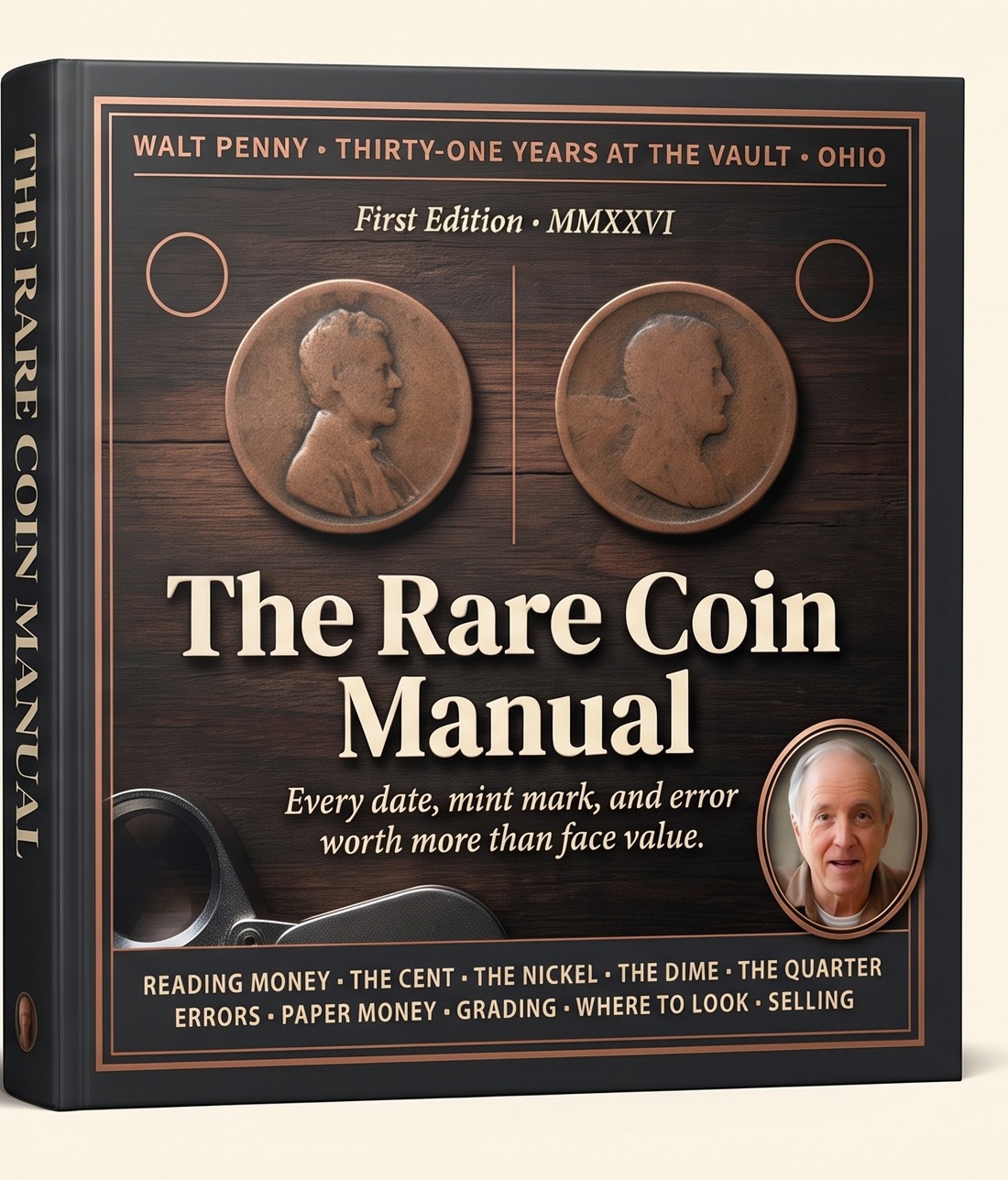
The Rare Coin Manual

Every date, mint mark, and error worth more than face value — with a 2026 value range and the known fakes beside each one.

The Rare Coin Manual by Walt Penny — First Edition 2026

You already own the raw material. It is in the jar on the dresser, in the cup holder, in the roll of quarters from the bank. What you don't have is the order to check it in, and that is the entire difference between a jar of change and a collection.

The manual is 146 pages and 28 chapters, built to be worked with rather than read through. Part One teaches you to read a coin. Every part after that is a denomination, then the errors, then grading, then where to look, then how to sell without getting taken. The Complete Check List at the back is the whole book compressed onto a few pages, for when you already know what you're doing and just need the number.

$27 until the launch promo ends at midnight. After that it is $47.

First Edition · 2026 The Rare Coin Manual
  • The complete 146-page illustrated manual, 6 × 9 — emailed to you within about a minute
  • All 28 chapters: cents, nickels, dimes, quarters, halves, dollars, paper money
  • The Five Minute Coin Check — the exact sequence, right at the front
  • A 2026 retail value range and the known fakes beside every coin
  • The Complete Check List — every coin and what to check, on one run of pages
  • Grading, certification, storage, and what each type of buyer actually pays
  • Glossary, Where To Look Things Up, and printable Search Log pages
$47 $27
Get The Rare Coin Manual — $47 $27

Instant download · Yours forever

Visa · Mastercard · Amex · PayPal · Apple Pay
Section VII · Questions

Questions I Get Asked

Are these coins really still out there, or is this one of those channels?

The famous ones — the 1943 copper cent, the 1969-S doubled die — turn up a handful of times a decade, and I say so plainly in the book. What is genuinely still in circulation is the modern material: Chapter 7 is nothing but cents from the last forty years still moving through registers right now. The honest promise is a steady stream of coins worth twenty to a few hundred dollars, not a lottery ticket. If a book promises you the lottery ticket, put it down.

Your videos are free. Why would I buy the manual?

Because a video has to be exciting for eight minutes and a manual only has to be true. A video shows you one coin. The manual gives you every coin in a denomination in one place, in checking order, with the value range and the fakes beside it — and you can have it open on the table next to the jar, which you cannot do with a video. The reference section is the part readers say they use most, and it would make for a terrible video.

Why is it only $27?

Because I want it in front of people who have a jar of change and no idea what is in it, and those are not people who spend a hundred dollars on a reference book. It costs me nothing to send a file. $47 is what it goes to once the launch promo ends; $27 is the launch number.

What format is it, and can I print it?

It is a PDF — 146 pages, First Edition 2026, set at 6 × 9 inches. It is illustrated with engraved-style plates rather than photographs: each of the nine parts opens on a full-page plate, and the chapters run with ruled comparison tables for the dates and values. It opens on a phone, a tablet, a laptop or an e-reader, and it prints cleanly on ordinary paper if you would rather keep it in a binder — the Search Log pages at the back were designed to be printed. Delivery is instant, it arrives by email within about a minute, and the file is yours to keep.

Do I need expensive equipment to use it?

No. Chapter 3 lays out what the book calls the Twenty Dollar Starting Kit: a 7x loupe at $8–15, a digital scale that reads to 0.01 g at $10–15, a $1 magnet, cardboard 2x2 holders at $5 per hundred, and a soft cloth to work on, which costs nothing. That is the whole kit for real work. You can also spend four hundred dollars on things you will never use — Chapter 3 is mostly about saving you from that second one.

I've been collecting for years. Is this too basic?

Part One will be review for you. Chapters 19, 23, 26 and 27 are the ones experienced collectors write to me about — the machine-doubling test, honest self-grading, what each buyer actually pays, and when paying to certify a coin makes financial sense rather than emotional sense. If you have ever sent a coin to be graded and lost money on the transaction, Chapter 27 is the chapter.

Will the values in the book still be right next year?

Every figure is an approximate 2026 retail range and every one of them will move — coin values run on a market like anything else. Use the numbers the way you would use a weather forecast: good for knowing whether to bring a coat, not good for planning to the minute. Chapter 26 shows you how to check a live price in about ninety seconds, free, before you buy or sell anything.

Walt Penny
Wait — one thing

Less Than One Wheat Cent.

The whole manual is $27 until midnight. That is less than a single decent wheat penny — for the book that tells you which of the ones in your jar is worth keeping.

Get The Rare Coin Manual — $47 $27 or see what's inside →